Worth County Dog Registration Information
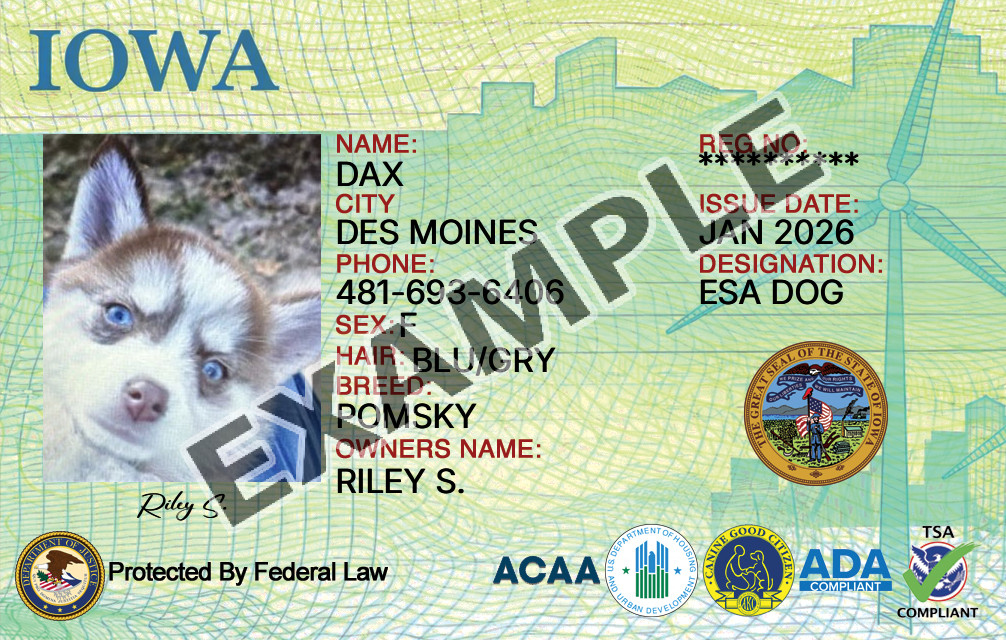
Service Dogs and Emotional Support Animals in Worth, Iowa
If you’re asking, “where do I register my dog in Worth County, Iowa for my service dog or emotional support dog,” the key thing to know is that there are usually two separate topics involved: (1) your local dog license in Worth County, Iowa (sometimes called a dog tag or dog licensing requirement), and (2) your dog’s status as a service dog or emotional support animal (ESA). Local licensing is handled by local government offices, while service dog and ESA status is established through disability-related laws and (for ESAs) housing documentation—not through one universal federal registry.
- There is no single federal “service dog registry” or “ESA registry” that you must use to be legally recognized.
- Local dog licensing (if required where you live) is separate from whether a dog is a service dog or an emotional support animal.
- Most licensing processes require proof of current rabies vaccination and basic owner/pet information.
Where to Register or License Your Dog in Worth County, Iowa
The office below is an official Worth County government office with verified public contact details. If you live inside a city limit (for example, Northwood or another incorporated community), you may also have city-specific rules that affect licensing, fees, or where tags are issued. When in doubt, start with the county office below and ask whether your address is licensed through the county or your city.
Worth County Auditor’s Office (Courthouse)
- Confirm whether your residence is handled at the county level or through a city clerk/city hall process.
- Explain what documentation is needed to obtain or renew a dog license (often including rabies vaccination proof).
- Help you understand deadlines, renewals, and any local instructions specific to Worth County, Iowa.
Overview of Dog Licensing in Worth County, Iowa
What “registering your dog” usually means
In most Iowa communities, “registering” a dog refers to obtaining a local dog license (often a numbered tag that attaches to a collar). A license helps local authorities identify ownership, supports rabies-control efforts, and can make it easier to reunite a lost dog with its owner. This is why residents commonly search for phrases like where to register a dog in Worth County, Iowa or animal control dog license Worth County, Iowa.
County vs. city rules inside Worth County
Worth County includes multiple communities and rural areas. Depending on where you live:
- City residents may have city ordinances for licensing, running-at-large rules, and nuisance regulations.
- Rural residents may follow county-level requirements or guidance.
Because local requirements can differ by municipality, the fastest path is to provide your address to the official office and ask where licensing is administered for your specific location.
What You Need Before Registering a Dog
Common documents and information to gather
While exact dog licensing requirements Worth County, Iowa can vary by jurisdiction, many local licensing processes ask for:
- Rabies vaccination proof (certificate or veterinarian documentation showing current status)
- Owner identification (driver’s license or other photo ID)
- Proof of residency (especially if licensing is tied to city limits or county residency)
- Basic pet details (name, breed/type, color/markings, sex, age)
- Spay/neuter documentation (if your local schedule has different fees for altered vs. unaltered pets)
Service dogs and ESAs: what to have ready
If your question is driven by a service dog or emotional support animal, these items may help in the contexts where they apply (not as a “registration” requirement):
- Service dog: clarity on the tasks the dog is trained to perform related to a disability (for access questions).
- Emotional support animal (ESA): housing-related documentation if requested for a reasonable accommodation (the need is typically tied to disability and housing rules, not public-access rules).
Steps to Register or License a Dog in Worth County, Iowa
Step-by-step process (typical local workflow)
- Confirm where you should license: Contact the official office listed above and ask whether your address is licensed through the county or through your city.
- Verify rabies documentation: Make sure your dog’s rabies vaccination is current and you have documentation available.
- Provide owner/pet details: Be ready with your contact information and a description of your dog.
- Pay the applicable fee: Fees can vary (often by spay/neuter status and whether it’s a renewal vs. new license).
- Keep the tag accessible: If your jurisdiction issues a physical tag, keep it on your dog’s collar per local expectations and keep any paper record for your files.
How this relates to service dog or ESA status
A dog can be both (a) locally licensed and (b) a service dog or emotional support animal. The licensing step is about local animal regulation; the service dog/ESA step is about disability-related rights and rules. One does not replace the other.
Service Dog Laws in Worth County, Iowa
No universal “service dog registration” requirement
Service dogs are not made “official” by a single nationwide registry. In general, a service dog is a dog that is individually trained to do work or perform tasks for a person with a disability. The dog’s legal status comes from meeting that definition and being used by a person with a disability—not from purchasing a certificate or signing up in a database.
Service dog vs. local licensing
Even if your dog is a service dog, you may still need to follow local animal rules that apply to all dogs in your area, such as:
- Local dog license requirements (if applicable where you live)
- Rabies vaccination requirements
- Leash and running-at-large rules
- General public safety requirements
If you’re uncertain how these apply at your address, ask the licensing office to explain the local rule for a service dog living in Worth County, Iowa.
Public access basics (practical expectations)
In day-to-day situations, service dog access questions are usually separate from the dog license process. Public access typically depends on whether the dog is trained to perform tasks for a disability and whether the dog is under control and housebroken.
Emotional Support Animal Rules in Worth County, Iowa
ESAs are not the same as service dogs
An emotional support animal (ESA) generally provides comfort by its presence but is not necessarily trained to perform specific tasks the way a service dog is. Because of that, ESAs and service dogs are treated differently in many legal contexts.
Housing is where ESA documentation most commonly comes up
ESA questions most often arise in rental housing situations when a resident requests a reasonable accommodation. That is separate from the question of where to register a dog in Worth County, Iowa. Even if your dog is an ESA for housing purposes:
- You may still need to comply with local dog licensing and vaccination rules where you live.
- ESA status does not automatically change local licensing obligations.
Practical tip for Worth County residents
If your goal is to be compliant both for housing and local regulations, handle these as two parallel tasks: (1) confirm the correct local licensing office for your address and license your dog if required, and (2) keep your housing-related documentation organized for accommodation requests.
Dog License vs. Service Dog vs. Emotional Support Animal (Comparison)
| Category | What it is | Who issues it | Typical proof | What it affects |
|---|---|---|---|---|
| Dog license (dog tag) | A local registration/licensing record for a dog living in a specific jurisdiction (county/city), often tied to rabies control and identification. | Local government (county and/or city office) depending on where you live within Worth County. | Rabies vaccination documentation; owner/pet information; fee payment (varies locally). | Local compliance, identification if lost, and sometimes access to local services (rules vary by jurisdiction). |
| Service dog | A dog individually trained to perform specific tasks for a person with a disability. | Not issued by a universal registry; legal status is based on meeting the definition under applicable disability laws. | Task-training and disability-related use; the dog must be under control and housebroken in public settings. | Disability-related access rights in many public settings when conditions are met. |
| Emotional support animal (ESA) | An animal that provides emotional support/comfort by presence; typically not task-trained like a service dog. | Not a universal registry. Documentation usually comes up in housing accommodation contexts. | Housing-related documentation supporting the need for an accommodation (when required by housing rules). | Most commonly impacts housing accommodations; generally not the same public-access status as a service dog. |
Frequently Asked Questions
Register A Dog In Other Iowa Counties
Select your county below to get started with your dog’s ID card. Requirements and license designs may vary by county, so choose your location to see the correct options and complete your pup’s registration.
- Adair Dog License Cards
- Adams Dog License Cards
- Allamakee Dog License Cards
- Appanoose Dog License Cards
- Audubon Dog License Cards
- Benton Dog License Cards
- Black Hawk Dog License Cards
- Boone Dog License Cards
- Bremer Dog License Cards
- Buchanan Dog License Cards
- Buena Vista Dog License Cards
- Butler Dog License Cards
- Calhoun Dog License Cards
- Carroll Dog License Cards
- Cass Dog License Cards
- Cedar Dog License Cards
- Cerro Gordo Dog License Cards
- Cherokee Dog License Cards
- Chickasaw Dog License Cards
- Clarke Dog License Cards
- Clay Dog License Cards
- Clayton Dog License Cards
- Clinton Dog License Cards
- Crawford Dog License Cards
- Dallas Dog License Cards
- Davis Dog License Cards
- Decatur Dog License Cards
- Delaware Dog License Cards
- Des Moines Dog License Cards
- Dickinson Dog License Cards
- Dubuque Dog License Cards
- Emmet Dog License Cards
- Fayette Dog License Cards
- Floyd Dog License Cards
- Franklin Dog License Cards
- Fremont Dog License Cards
- Greene Dog License Cards
- Grundy Dog License Cards
- Guthrie Dog License Cards
- Hamilton Dog License Cards
- Hancock Dog License Cards
- Hardin Dog License Cards
- Harrison Dog License Cards
- Henry Dog License Cards
- Howard Dog License Cards
- Humboldt Dog License Cards
- Ida Dog License Cards
- Iowa Dog License Cards
- Jackson Dog License Cards
- Jasper Dog License Cards
- Jefferson Dog License Cards
- Johnson Dog License Cards
- Jones Dog License Cards
- Keokuk Dog License Cards
- Kossuth Dog License Cards
- Lee Dog License Cards
- Linn Dog License Cards
- Louisa Dog License Cards
- Lucas Dog License Cards
- Lyon Dog License Cards
- Madison Dog License Cards
- Mahaska Dog License Cards
- Marion Dog License Cards
- Marshall Dog License Cards
- Mills Dog License Cards
- Mitchell Dog License Cards
- Monona Dog License Cards
- Monroe Dog License Cards
- Montgomery Dog License Cards
- Muscatine Dog License Cards
- O'Brien Dog License Cards
- Osceola Dog License Cards
- Page Dog License Cards
- Palo Alto Dog License Cards
- Plymouth Dog License Cards
- Pocahontas Dog License Cards
- Polk Dog License Cards
- Pottawattamie Dog License Cards
- Poweshiek Dog License Cards
- Ringgold Dog License Cards
- Sac Dog License Cards
- Scott Dog License Cards
- Shelby Dog License Cards
- Sioux Dog License Cards
- Story Dog License Cards
- Tama Dog License Cards
- Taylor Dog License Cards
- Union Dog License Cards
- Van Buren Dog License Cards
- Wapello Dog License Cards
- Warren Dog License Cards
- Washington Dog License Cards
- Wayne Dog License Cards
- Webster Dog License Cards
- Winnebago Dog License Cards
- Winneshiek Dog License Cards
- Woodbury Dog License Cards
- Wright Dog License Cards
